Practical Communication exercises for couples can make a real difference in relationship satisfaction. Research on couples therapy shows that couples who learn specific communication skills see meaningful improvement, while those who wait for help often see almost no change. We created this guide to share practical, kind, and realistic exercises you can start using together today.
Key Takeaways
| Question | Answer |
|---|---|
| What are the most effective communication exercises for couples? | Exercises that structure active listening, “I” statements, and deep conversation tend to help the most. We share step‑by‑step activities inspired by our full guide on communication exercises for couples. |
| How can we fix recurring communication problems in marriage? | Start with short, regular check‑ins and clear rules for difficult talks, similar to the strategies in our resource on communication problems in marriage. |
| Can simple daily habits really improve our relationship? | Yes, consistent small habits like appreciation rituals and 10‑minute talks often support the “big” relationship goals, as we explain in 5 secrets to building the best relationship. |
| Are these exercises only for struggling couples? | No, couples at every stage, from early dating to long‑term marriage, can benefit. You can even adapt first‑date style prompts from first date conversation starters to deepen long‑term connection. |
| What if we keep arguing when we try to talk? | Use “pause and repair” exercises and argument reset steps similar to those in how to fix an argument in a relationship to cool down before continuing. |
| Where can we find more communication tools and topics? | Explore our wider relationships collection for extra scripts, conversation ideas, and deeper topics to explore together. |
1. Practical Communication Exercises for Couples: How They Help You Reconnect
Many couples care deeply about each other, yet still end up feeling misunderstood, dismissed, or alone. Structured communication exercises give you a clear path so you do not have to “wing it” every time you talk about something important.
Across dozens of studies, couple‑focused skills training has been associated with meaningful gains in satisfaction, connection, and mental health, especially when partners learn how to listen and respond differently. You are not broken if you struggle to communicate; you may simply be missing a set of learnable tools.
From vague talks to guided conversations
When you rely only on spontaneous talks, it is easy to get stuck in old patterns, like criticism, defensiveness, or shutting down. Practical exercises add gentle structure, which can help both of you stay calmer and feel safer.
We built our in‑depth guide on communication exercises for couples: deep conversation around this idea, breaking big skills into bite‑sized practices you can repeat.

2. Active Listening Exercise: Hearing Your Partner Fully
Active listening is one of the most researched and recommended communication skills for couples. It focuses less on “fixing” and more on making sure your partner feels heard, which can lower defensiveness and tension.
Here is a simple active listening exercise you can try several times a week, especially for everyday topics that feel emotionally loaded but not overwhelming.
Step‑by‑step active listening practice
- Pick a neutral time, not in the middle of a fight.
- Set a timer for 5 minutes.
- Partner A speaks about a current feeling or situation, using “I” statements.
- Partner B listens without interrupting, fixing, or defending.
- When time is up, Partner B reflects back what they heard: “What I hear you saying is…”
- Partner A confirms or corrects, then you switch roles for another 5 minutes.
You can adapt this exercise when you discuss specific relationship issues, as described in our post on communication problems in marriage. Remember that active listening does not mean you agree, it simply means you prioritize understanding before responding.

3. “I” Statement Exercise: Speaking Without Blame
Many arguments spiral because complaints come out as criticism, which naturally triggers defensiveness. “I” statements help you describe your feelings and needs without attacking your partner’s character.
One commonly suggested structure is: “I feel [emotion] when [situation] and I need / would like [specific request].” It is simple, but it often takes practice to use in the heat of the moment.
Turn common fights into “I” statements
Take a few recurring conflicts and rewrite what you usually say into “I” statements together. You can even treat it like a mini workshop at the kitchen table.
| Typical Reaction | “I” Statement Version |
|---|---|
| “You never listen to me.” | “I feel ignored when I am sharing something important and you are on your phone. I would like us to put phones away for 10 minutes while we talk.” |
| “You are always late.” | “I feel unimportant when we agree on a time and you arrive much later. I would like us to agree on a time we can both realistically meet.” |
This exercise is especially powerful when combined with the broader relationship habits we discuss in 5 Unbreakable Secrets to building the best relationship, such as consistent effort and shared values.

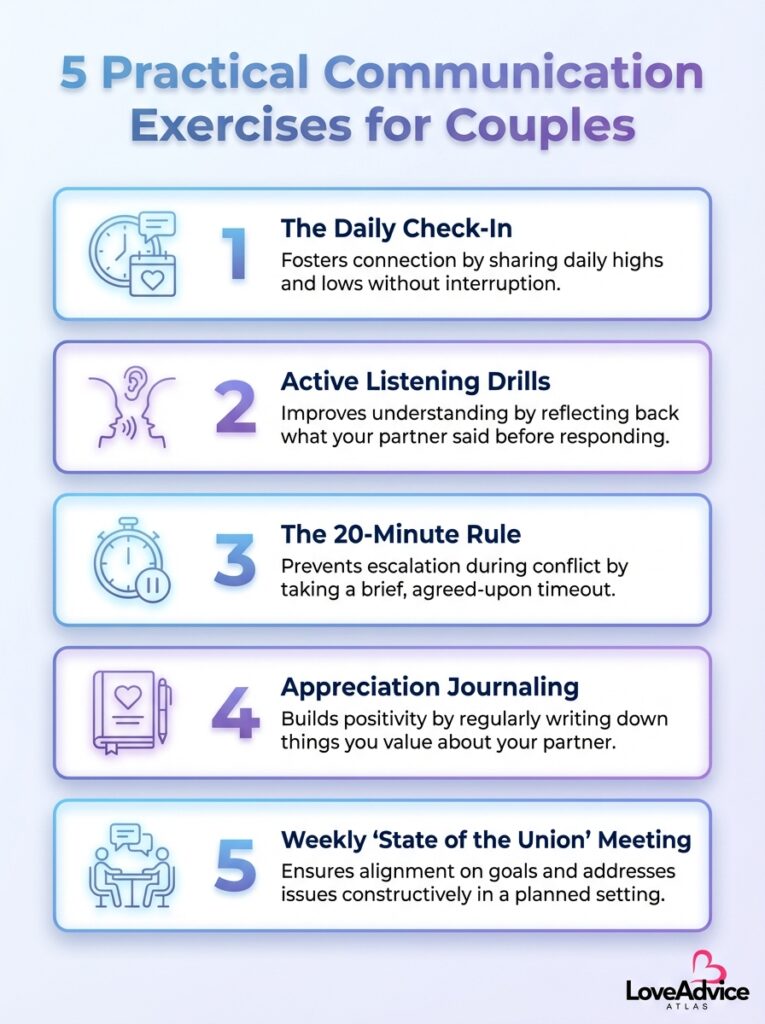
Five practical communication exercises for couples are outlined in this infographic. Use these quick activities to boost understanding and connection.
Did You Know?
In a 2024 randomized trial of a couple-focused dyadic coping intervention for colorectal cancer, couples who learned structured communication and coping skills reported significant improvements in marital satisfaction, mental health, and depression compared with controls.
4. Deep Conversation Starters: Going Beyond “How Was Your Day?”
Shallow small talk is not bad, but if it is all you have, you may start to feel distant over time. Deep conversation exercises invite you to share hopes, fears, and stories that build emotional intimacy.
You do not need dramatic questions for this; you just need prompts that invite more than one‑word answers and that both of you feel safe exploring.
Using prompts to open up gently
Try choosing 3 to 5 prompts once a week and answering them one by one over coffee, a walk, or a relaxed evening at home. You can borrow ideas from the playful tone of our first date conversation starters, then adapt them for your stage of the relationship.
- “What is one small moment from this week that made you feel cared for?”
- “What is something you are worried about that you have not said out loud yet?”
- “What kind of couple do you hope we are five years from now?”
5. Daily Check‑In Ritual: 10 Minutes To Reconnect
Big relationship changes often come from small daily habits. A simple 10‑minute check‑in can prevent minor frustrations from turning into major resentments.
This exercise works especially well for busy partners or those juggling demanding careers, similar to the work‑life themes we address in our articles on balancing relationships and other priorities.
How to structure a daily check‑in
Pick a consistent time, like after dinner or before bed, and commit to it as much as possible. Use the same three questions each time, so your nervous system starts to recognize this as a safe and predictable space.
- “What is one thing that went well for you today?”
- “What is one thing that felt hard for you today?”
- “Is there anything you need from me tonight or tomorrow?”

6. Appreciation & Affection Exercise: Strengthening the Positive
Communication is not only about solving problems, it is also about noticing and naming what is working. Regular appreciation can act as a buffer when stress or conflict shows up.
This exercise is short and simple, which makes it easier to keep doing even on harder days or during tense seasons in your relationship.
Three good things about you
Once or twice a week, set aside 5 minutes and take turns naming three specific things you appreciate about each other. Focus on actions, efforts, or qualities you sincerely notice.
- “I appreciate that you made coffee this morning when you knew I had an early meeting.”
- “I appreciate how patient you were with me when I was stressed yesterday.”
- “I appreciate your sense of humor; it lightens my mood so often.”
You can pair this with heartfelt messages, similar to the ideas we share in relationship text messages, to reconnect and to keep the positive energy going during the day.

7. Conflict “Time‑Out & Repair” Exercise
No couple communicates all the time perfectly. What often matters most is how quickly and kindly you repair after a rupture.
A planned “time‑out and repair” exercise helps you pause escalating fights and return to the conversation in a calmer, more caring way, instead of saying things you later regret.
Agreed‑upon rules for cooling down
Together, decide on a signal or phrase that means “I need a pause” and agree that you will both respect it. Set a time window, like 20 to 60 minutes, then come back to a specific place to continue the talk more slowly.
- No storming out without saying where you are going or when you will be back.
- No using the pause to punish or withdraw for days.
- Use the break to self‑soothe, not to rehearse counter‑arguments.
We explore practical repair steps in more depth in our guide on how to fix an argument in a relationship, which can be helpful if you feel stuck in repeating conflict cycles.

Did You Know?
Meta-analytic research on Emotionally Focused Couple Therapy, which often centers on structured communication and repair conversations, reports pre-post effect sizes around d = 0.93, indicating large improvements in couple functioning across multiple studies.
8. Future Vision Exercise: Designing Your Shared Story
It is easier to talk constructively about tough topics when you know you are on the same team. A future vision exercise helps you remember that you are building a life together, not just surviving day to day.
This is especially helpful during times of uncertainty, such as career changes, family transitions, or after trust has been shaken.
Create a “Relationship Roadmap” together
Set aside an hour and sit somewhere comfortable with paper or a shared note. Each of you privately writes answers to a few questions, then you compare and discuss.
- “What kind of emotional environment do I want in our home?”
- “How do I want us to handle conflict two years from now?”
- “What are three experiences I hope we share in the next 5 years?”
Use overlapping answers as your “north stars” and treat differing answers as starting points for curious, respectful conversation, not proof that you are incompatible.
9. Self‑Reflection Exercise: Understanding Your Own Communication Style
Healthy communication is not just about what your partner does differently, it is also about recognizing your own patterns. Gentle self‑reflection can make you more aware of your triggers and habits.
When you understand yourself better, it becomes easier to explain your needs clearly and to ask for specific support rather than hoping your partner will read your mind.
Personal communication journal prompts
Take 10 to 15 minutes on your own once a week to answer a few prompts in a notebook or app. You do not have to share every answer, but you can share what feels helpful with your partner.
- “When I feel hurt, do I tend to attack, shut down, or try to fix?”
- “What kinds of words or tones make me feel safest during conflict?”
- “What did I see growing up about how people communicate when they disagree?”
Our self‑love resources can support this internal work, since stronger self‑esteem and self‑understanding often help couples communicate more calmly and respectfully.

10. When To Add Professional Support To Your Exercises
Sometimes, no matter how many exercises you try, conversations still feel stuck or unsafe. That is not a failure on your part; it can simply mean you are facing patterns that benefit from professional guidance.
Evidence suggests that structured therapies and some guided online programs can create meaningful improvements for many couples, especially when emotional wounds or long‑standing patterns are involved.
Signs it might be time to seek help
- You feel afraid to bring up certain topics because of your partner’s reactions.
- Most conversations about the relationship end in shutting down, stonewalling, or explosive conflict.
- There has been a major breach of trust, such as infidelity or ongoing dishonesty.
If you recognize yourselves here, you might explore options like in‑person or online support, similar in spirit to the resources we discuss in our article on relationship counseling and couples therapy. Professional support can work alongside the exercises in this guide, not replace them.
11. Putting It All Together: A Weekly Communication Plan
It can feel overwhelming to see many exercises at once. To keep things manageable, we encourage you to start small and choose just a few practices to repeat regularly.
You can always add more later as they start to feel more natural and as your confidence grows.
Sample one‑week communication practice schedule
| Day | Exercise |
|---|---|
| Monday | 10‑minute daily check‑in |
| Tuesday | Active listening exercise (5 minutes each) |
| Wednesday | Appreciation exercise (3 specific appreciations) |
| Thursday | Self‑reflection journal on communication |
| Friday | Deep conversation prompts (3 questions) |
| Weekend | Future vision exercise or review of how the week’s talks felt |
Remember that it is okay to adapt this plan to your schedules, energy levels, and unique relationship needs. The goal is not perfection; it is a steady pattern of small, caring efforts over time.
Conclusion
Practical communication exercises for couples are not about becoming perfect communicators; they are about creating more moments where both of you feel seen, heard, and cared for. Even small practices like daily check‑ins, “I” statements, or a few deep questions each week can gently shift long‑standing patterns over time.
As you experiment with these exercises, be kind to yourselves and remember that every couple is a work in progress. You do not have to fix everything at once; you just have to keep choosing each other and taking the next small, honest conversation together.