

How to rebuild trust after betrayal is a question many people ask when trust is shattered, and it feels like your entire world has cracked open. With good reason, too, especially when you learn that 58% of consumers say a breach damages their trust in a brand and 70% would stop shopping with that brand after a security incident. Whether you are healing from betrayal in a relationship or dealing with a data breach that shook your customers’ confidence, rebuilding trust is possible with clear steps, patience, and honest repair.
Key Takeaways
| Question | Short Answer |
|---|---|
| How do you start rebuilding trust after a betrayal or breach? | Begin with full honesty, clear acknowledgment of harm, and a shared decision to try again, then use guided steps like those in this 8-step broken trust guide. |
| Can trust really be rebuilt after cheating or a major lie? | Yes, many couples do rebuild and even create stronger relationships, especially when they follow structured healing processes like those shared in our broken trust healing steps. |
| What if you are not sure whether to stay or leave? | It is normal to feel torn; for some, exploring questions similar to those used in divorce decisions, like in the divorce recovery archive, can clarify what you really want. |
| How important is communication in rebuilding trust? | It is essential; consistent, kind, and transparent communication, like the practices found in our broader relationship guidance collection, creates the safety needed for trust to grow again. |
| Should we get outside help after a breach of trust? | Many couples and individuals heal faster with structured support, similar to the approaches discussed in our relationship counseling and couples therapy guide. |
| What if my self-esteem is shattered after betrayal? | Rebuilding self-trust and self-worth is just as important as repairing the relationship; our self-love resources focus on nurturing you as an individual. |
1. Understanding What “Trust After a Breach” Really Means
When trust is broken, it is not just about the single event; it is about the emotional shock, the loss of safety, and the sudden question of what is real. We see this in romantic betrayal, emotional affairs, serious lies, and also in digital or data breaches, where people feel exposed and unprotected.
Rebuilding trust after a breach means creating new conditions where safety, honesty, and reliability are strong enough to hold both pain and hope. It does not mean pretending the breach never happened; it means building a different, more honest future on top of what you now know.
Relational vs structural trust
In intimate relationships, broken trust often comes from infidelity, secret-keeping, or repeated broken promises. In digital contexts, a breach might mean leaked personal data, compromised credentials, or mishandled information that people trusted you with.
In both cases, people are asking the same question: “Can I rely on you again?” Our work at Love Advice Atlas is to help you answer that question with clarity, not pressure.

2. First Response: The First Step in How to Rebuild Trust After Betrayal
The first hours and days after discovering a betrayal or breach are often filled with shock and overwhelm. This is the moment when many people say or do things from panic instead of intention, which can deepen the wound.
We encourage you to slow down and focus on three essentials: safety, clarity, and containment. You do not need to make permanent decisions on day one; you do need to protect your emotional and practical safety.
For personal relationships
- Pause big decisions like breaking up, moving out, or announcing the breach to everyone.
- Ask direct, necessary questions about what happened, without demanding every tiny detail that might retraumatize you.
- Set immediate boundaries, such as space for a few days, or agreements about communication.
For digital or data breaches
- Secure accounts, change passwords, and contain technical damage as quickly as possible.
- Prepare simple, honest language about what happened and who is affected.
- Avoid vague reassurances, be concrete about what you know and what you are doing next.
3. Honest Acknowledgment: Owning What Happened Without Defensiveness
Trust cannot grow on top of minimization or half-truths. Whether you hurt a partner or your organization was responsible for a data incident, clear acknowledgment is the foundation of repair.
Acknowledgment means saying, “This is what I did, this is how it impacted you, and I am not going to hide from it.” It does not mean flooding the other person with self-blame; it means taking steady, accountable responsibility.
What real accountability sounds like
- “I lied about where I was and who I was with. I know that shattered your sense of safety.”
- “Our systems did not protect your data the way they should have. Your information was exposed, and we understand how serious that is.”
Defensiveness, blame-shifting, or saying “Everybody makes mistakes” too quickly will usually slow healing. We guide people to sit with discomfort long enough for genuine remorse to come through in actions, not just words.

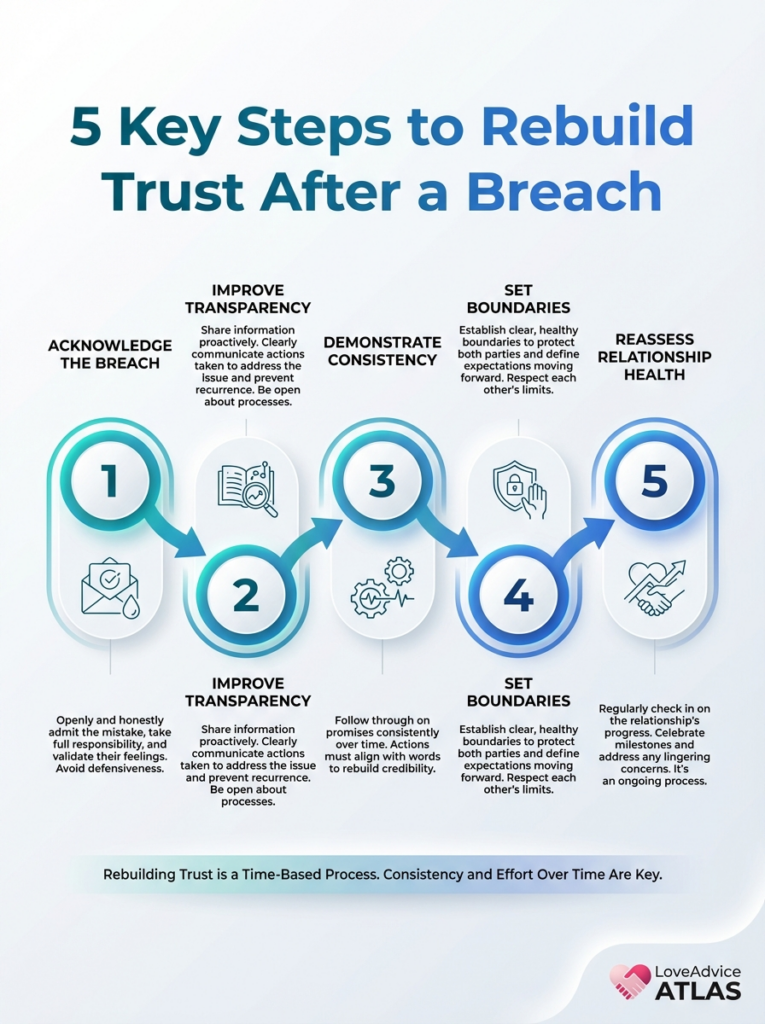
This infographic outlines five essential steps to regain trust after a data breach, helping security teams communicate resilience to stakeholders. Follow these steps to restore credibility and strengthen post-breach response.
4. Transparency and Timely Disclosure: Why Time Matters So Much
One of the deepest injuries after a breach is the sense that important information was hidden or delayed. In relationships, people often say, “If you had told me sooner, it would still hurt, but I would have felt more respected.”
In the digital world, long delays in breach notification can severely damage trust, especially when people later realize their information was at risk for months without their knowledge.
Time, honesty, and emotional safety
- Share what you know as soon as you can reasonably verify it.
- Say clearly what you do not know yet, and commit to follow-up updates.
- Avoid waiting for the “perfect” explanation; aim for honest, evolving communication.
People can often forgive mistakes faster than they can forgive being kept in the dark. Even if your voice shakes, speaking earlier and more clearly is usually a powerful trust-building step.
Did You Know?
Breach notifications took an average of 205 days after an incident in 2024, and long delays like this can deeply erode trust that might otherwise be repairable.
5. Emotional Validation: Making Space For Hurt Without Rushing Forgiveness
Trust repair is not a quick “fix,” it is an emotional process where the injured person needs to feel seen, believed, and cared for. Too often, the person who caused the breach feels ashamed and wants to move past it quickly, which can leave the hurt person feeling pressured to “get over it.”
We encourage a different approach: let emotions be heard and expressed in manageable doses, with agreements that keep discussions from becoming cruel or chaotic.
What emotional validation looks like
- Listening to anger, sadness, and fear without interrupting or arguing with the feelings.
- Responding with phrases like, “It makes sense that you feel that way, given what happened.”
- Avoiding statements like, “I said I am sorry, what more do you want?” shut down healing.
In organizational or data breaches, emotional validation might mean publicly acknowledging customers’ frustration and anxiety, rather than hiding behind technical language. People want to know that you understand the human impact, not just the system impact.

6. Concrete Behavior Changes: Showing, Not Just Saying, That You Are Safe Again
Apologies are important, but alone they are not enough to rebuild trust after a breach. People begin to relax and open their hearts again when they see consistent, predictable, respectful behavior over time.
This is true whether we are talking about changing how you interact in a relationship or strengthening protections around sensitive information.
Examples of tangible trust-building actions
| Context | Helpful Actions |
|---|---|
| After infidelity or lying | Sharing schedules, being reachable when you say you will be, ending contact with the affair partner, attending counseling together. |
| After a data or privacy breach | Implementing stronger authentication, regular security reviews, clear privacy updates, and support channels for affected people. |
Our article on how to build trust and earn loyalty dives deeper into practical, everyday behaviors that rebuild credibility and emotional safety.
7. Balancing Individual Healing and Relationship Repair
After a breach, there are always two journeys happening at once: the relationship’s journey and each person’s individual healing. If you only focus on the relationship, you might ignore deep personal wounds or self-doubt that need care.
If you only focus on individual healing, you might miss chances to create new patterns together that feel healthier and safer for both of you.
Rebuilding self-trust and self-worth
Many people ask, “What is wrong with me that I did not see this coming?” or “Why did I allow this?” These are painful questions that deserve gentle, non-blaming exploration. Working with resources that focus on self-love and personal growth, similar to the material in our self-love archive, can support you in rebuilding confidence.
At the same time, you and your partner or your organization can address patterns that led to the breach, such as poor boundaries, unspoken resentments, or ignored security warnings. Both levels matter.
Did You Know?
68% of breaches involve human error, which means that long-term trust repair almost always requires better communication, training, and healthier everyday habits, not just technical fixes.
8. Using Structured Support: Counseling, Guides, and Relationship Resources
Trying to rebuild trust alone can feel like walking through a storm without a map. Many couples and individuals feel relief when they realize there are structured, step-by-step processes designed specifically for moments like this.
Professional relationship counseling, couples therapy, and guided exercises can provide neutral ground where both people are heard and where old patterns are gently challenged.
When outside help makes sense
- You feel like every conversation turns into a fight or shutdown.
- One person wants to rebuild, and the other is unsure or emotionally numb.
- There are repeated breaches or long-term patterns that feel stuck.
If you feel drawn to more guided work, our overview of relationship counseling and couples therapy explains what to expect and how to choose the right kind of support for your situation.
9. Deciding Whether To Stay, Go, or Reset the Relationship
One of the hardest parts of any breach is deciding what comes next. Some people repair, some people part ways, and others choose a slower reset where they suspend big decisions while they see how sincere the repair efforts are.
It is okay if you do not know right away. In fact, giving yourself time to watch actions and listen to your own inner signals often leads to clearer, more grounded choices.
Questions to help you decide
- Is the person or organization taking ongoing responsibility and making concrete changes, or just offering words?
- Do you see a pattern of disregard, or does this ring true as a painful but out-of-character event?
- What do you need, emotionally and practically, to feel safe staying?
Some readers find it helpful to explore decision-focused resources, similar in spirit to the reflective questions raised in our divorce category, even if they are not planning to separate. The point is clarity, not pressure.
10. Long-Term Maintenance: Keeping Trust Strong After You Rebuild It
Once you have done the hard work of rebuilding, it can be tempting to relax and hope the work is over. In reality, trust is like a living system that needs consistent care.
This does not mean living in punishment forever. It means adopting daily and weekly practices that keep communication open and behavior aligned with your shared values.
Simple maintenance habits that protect trust
- Regular check-ins about how safe and connected you both feel.
- Agreed communication rules for tough topics, such as taking breaks instead of saying things you will regret.
- Ongoing attention to emotional and technical “vulnerabilities,” like old resentments or outdated security practices.
For many couples and individuals, returning to structured guides like Broken Trust? 8 Steps to Rebuild and Move Past Infidelity or the broader relationships archive every few months can serve as a reset, reminding you of the principles that helped you heal in the first place.
Conclusion
Rebuilding trust after a breach, whether in love or in how you care for people’s information, is hard work, but it is not hopeless. Trust is not an on or off switch, it is a gradual, living process built through honesty, emotional care, and consistent choices over time.
As you move forward, remember that you are allowed to ask for what you need, set boundaries, and take your time. We are here to walk alongside you with compassionate, practical guidance, so you do not have to navigate this healing journey alone.