

Self-love and healthy relationships are deeply connected, especially in 2026, when emotional standards and boundaries are becoming clearer than ever. Did you know that 64% of women in 2025 reported that they are refusing to settle by setting much clearer boundaries on their emotional needs? This data proves that the quality of our romantic connections in 2026 depends entirely on the value we place on ourselves before we even enter the dating pool.
Key Takeaways
| Question | Expert Answer |
|---|---|
| Can a relationship survive without self-love? | While it may survive, it often lacks the resilience needed to handle conflict without resentment. Explore more in our self-love archives. |
| What is the first step to building self-worth? | The first step involves identifying your personal values and sticking to them even when lonely. |
| How do boundaries affect intimacy? | Boundaries create a safe space for vulnerability by ensuring both partners feel respected and secure. |
| Why do I keep attracting the same partners? | We often attract what we believe we deserve, so raising your self-worth changes your “attraction frequency.” |
| Can therapy help with self-love? | Professional guidance helps unlearn old patterns of self-criticism and replaces them with self-compassion. |
- Self-love acts as a filter that keeps toxic dynamics out of your life.
- Personal confidence reduces the need for constant external validation from a partner.
- Emotional stability allows you to communicate needs clearly rather than through passive aggression.
- Self-compassion leads to higher levels of affection and patience for your partner.
- Establishing a strong sense of self prevents you from losing your identity in a “situationship.”
Understanding the Core Connection Between Self-Worth and Love
We believe that love is not something you find but something you grow within yourself first. When we possess a strong sense of self-worth, we enter relationships as whole individuals rather than half-people looking for completion. This internal foundation allows us to navigate the complexities of 2026 dating with a sense of calm and clarity.
Without this foundation, we risk becoming a mirror of our partner’s moods and insecurities. It is common to mistake the “spark” of a new connection for a replacement for self-care. However, the most successful couples report that their bond is strongest when they maintain their individual hobbies and growth.
Defining the Difference in Relationship vs Companionship
We often see people settle for companionship because they fear being alone, which is a sign of low self-love. True relationships require a deep emotional investment and a commitment to mutual evolution that goes beyond simple company.
If you find yourself staying in a connection just to avoid an empty house, you might be looking for a companion rather than a life partner. Recognizing this distinction is the first step toward finding a love that truly honors your needs.
Relationship vs Companionship: High-Stakes Love
A high-stakes relationship involves shared goals and a willingness to work through significant life hurdles together. It requires a level of self-security that allows you to be vulnerable without fearing total rejection.
In contrast, a situationship often feels like a placeholder where boundaries are blurred and expectations are never quite met. You can learn more about these dynamics by exploring our guide on relationship vs companionship.
Setting Healthy Relationship Boundaries in Self-Love and Healthy Relationships
We view boundaries as the invisible lines that protect your emotional well-being and keep your relationship healthy. When we love ourselves, we are not afraid to say “no” to behaviors that compromise our peace. Setting a boundary is not about controlling your partner but about clearly stating what you need to feel safe and respected.
Individuals who lack self-love often view boundaries as walls that will drive people away. In reality, boundaries are the bridges that allow two people to connect without one person being consumed by the other. This clarity prevents the burnout and resentment that often plagues modern partnerships.
Did You Know?
Low self-esteem is a primary predictor of “over-accommodating” and seeking constant external validation, which correlates with higher relationship stress.
The Power of Non-Negotiables
We encourage you to create a list of non-negotiables that align with your deepest personal values. These might include honest communication, financial transparency, or a commitment to shared domestic labor.
For more help on establishing these standards, check out our insights on healthy relationship boundaries. Sticking to these rules is the ultimate form of self-respect.
Practicing Self-Compassion for Emotional Stability
Self-compassion is the art of being as kind to yourself as you would be to a dear friend. In 2026, we see this as a vital skill for maintaining emotional stability in a high-stress world. When we stop criticizing our own mistakes, we naturally become less critical of our partners. T
his creates an atmosphere of grace where both individuals feel free to grow without the fear of judgment. Research shows that high self-compassion directly translates into being perceived as more affectionate by your partner. It is the quiet strength that keeps a relationship grounded during turbulent times.
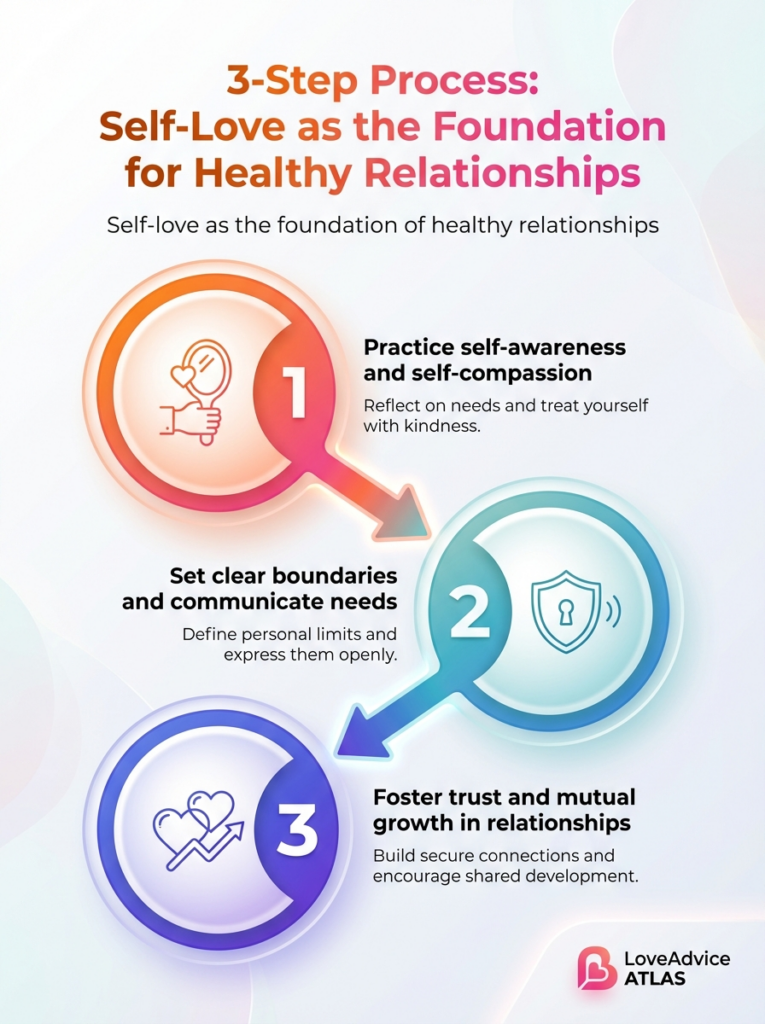
An infographic that outlines a 3-step process for building healthy relationships by making self-love the foundation. It connects self-care to trust, communication, and deeper connection.
Essential Communication Exercises to Build Mutual Respect
We believe that even the strongest self-love needs practical tools to translate into a thriving partnership. Communication exercises provide a structured way to share your inner world with your partner safely. Using “I” statements is one of the most effective ways to express a need without triggering a defensive response. For example, saying “I feel lonely when we don’t spend evening time together” is more effective than “You never spend time with me.” Active listening is another cornerstone of a healthy bond where the goal is to understand rather than to respond. This practice requires a level of internal patience that only comes from a settled sense of self.
You can find more practical drills in our guide to communication exercises for couples. These rituals ensure that both partners continue to feel seen and heard throughout the years.
Healing Your Heart After a Difficult Breakup
We know that breakups can feel like a total loss of identity, but they are often the most fertile ground for self-discovery. Learning how to sit with the pain without rushing into a new relationship is a profound act of self-care. It is during these quiet moments of recovery that we can reflect on the patterns that no longer serve us. Healing is not a linear process, and it requires immense patience with your own emotional pace.
“Healing is the process of returning to yourself after you have been lost in the service of someone else’s needs.”
If you are currently struggling with a split, please read our five steps on how to deal with a breakup. We are here to support you as you rebuild your life and your heart.
Implementing the No Contact Rule for Personal Growth
We often recommend the no contact rule as a tool for psychological preservation rather than a game to win an ex back. It creates the necessary space to break the emotional addiction to a partner who is no longer right for you. This period of silence allows you to shift your focus back to your own goals, health, and social connections.
Without the constant noise of communication, you can finally hear your own intuition again. By cutting off contact, you signal to yourself that your peace is more important than a toxic or unfulfilling connection. You can find out more about how this works in our deep dive into the no contact rule.
Balancing Professional Ambition with Romantic Intimacy
We see many modern women facing the difficult choice between their career trajectory and their personal relationships. This “work-life dilemma” often stems from the pressure to be perfect in every single area of life at once.
Self-love in this context means acknowledging that you cannot do everything alone and that your career success does not define your human worth. It involves setting boundaries at work to ensure there is enough emotional energy left for your partner.
True intimacy requires presence, which is hard to achieve if you are constantly checking emails during dinner. We have analyzed this struggle in our article on the relationship or career dilemma to help you find your balance.
Did You Know?
Couples who regularly practice mutual affirmation of self-worth report 30% higher emotional resilience during crises.
Building Confidence to Navigate the 2026 Dating Scene
We believe that confidence is the most attractive trait any dater can possess because it signals that you are not desperate for a “missing piece.” In 2026, dating should be treated as an exploration of compatibility rather than a performance to be liked.
When you enter a first date knowing your value, you focus on whether the other person is a good fit for *you*. This shift in perspective removes the anxiety of being judged and allows you to be your authentic self. Our dating archives offer more advice on how to keep your confidence high while meeting new people. Remember that a “no” from someone else is often a “yes” to your own future happiness.
The Role of Professional Counseling in Strengthening Bonds
We recognize that sometimes self-love and healthy communication require external support to truly take root. Relationship counseling is not a sign of failure but a commitment to building a more connected and evidence-based future.
A therapist can help identify the childhood wounds that might be preventing you from fully loving yourself or trusting your partner. This deep work creates a more stable foundation for long-term commitment and marriage. If you feel stuck in a loop of conflict, our services in relationship counseling and couples therapy can provide the tools you need. Investing in your relationship’s health is one of the highest forms of mutual respect.
The Long-Term Impact of a Self-Love Foundation
We have seen that couples who prioritize individual self-growth are the ones who stay together through life’s most difficult seasons. When both partners take responsibility for their own happiness, the relationship becomes a source of joy rather than a burden.
This foundation ensures that you are with your partner because you *want* to be, not because you *need* to be. This freedom is where true, lasting intimacy begins and where healthy relationships thrive in 2026. Explore more about long-term success in our relationships archives to keep your bond strong. We are here to walk this journey with you every step of the way.
Conclusion
In summary, self-love is not a luxury or a trend but the literal foundation upon which every healthy relationship is built. By prioritizing your own worth, setting clear boundaries, and practicing self-compassion, you create the space for a partner to love you properly.
Whether you are navigating a new dating scene or strengthening a long-term marriage, remember that your relationship with yourself sets the tone for everything else. Keep growing, keep loving yourself, and the right connection will naturally follow.