

Situationship vs real love is one of the biggest questions shaping modern dating in 2026. Defining your romantic status today often feels like navigating a maze without a map. The landscape of intimacy has shifted dramatically, with 82% of young women reporting they are officially finished with situationships and ambiguous romantic arrangements in favor of clear, defined partnerships.
Understanding where you stand is no longer just about a label. It is about protecting your emotional energy and ensuring your life trajectory aligns with your partner’s intentions.
Key Takeaways
| Feature | Situationship | Partnership |
|---|---|---|
| Commitment | Vague, present-focused, and non-contractual. | Explicitly stated with long-term intent. |
| Integration | Kept separate from family and major life events. | Deeply woven into social and familial circles. |
| Planning | Spontaneous or last-minute arrangements. | Calendar-based with shared future goals. |
- How do I know if I am in a situationship? If you find yourself constantly questioning your status or if plans are never made more than 48 hours in advance, you are likely in a situationship rather than a partnership.
- What is the main difference between companionship and partnership? While companionship focuses on casual shared activities, a true partnership involves high-stakes emotional investment and mutual accountability, as explored in our modern intimacy guide.
- Can a situationship become a relationship? Yes, but it requires a “Defining the Relationship” (DTR) conversation and a shift from low-stakes connection to contractual commitment.
- Why do I feel lonely in my relationship? Loneliness often stems from a lack of vulnerability, which is a hallmark sign of a situationship where emotional depth is avoided.
1. Emotional Investment and the Vulnerability Gap
In a partnership, vulnerability is the bedrock of the connection. You feel safe sharing your fears, failures, and career anxieties without the threat of the other person retreating. We believe that a relationship that requires you to change a non-negotiable part of your identity is doomed from the start.
Conversely, a situationship thrives on “surface-level” harmony. You might spend hours together, yet leave feeling like you haven’t actually been seen or heard. If you are constantly “walking on eggshells” to avoid being “too much,” you are likely trapped in a low-stakes companionship. Learning how to foster true commitment involves moving past this superficiality.
2. Future Orientation: The Calendar Test
One of the most pragmatic signs of a partnership is “future orientation.” When you are in a partnership, you appear in each other’s calendars for events months away. We view the love vs career dynamic not as a test of commitment, but as a reflection of security.
In a situationship, the future is a “no-go” zone for conversation. Plans are rarely made more than a week in advance because the arrangement is based on present-moment convenience. This lack of shared destiny keeps the relationship in a state of perpetual “purgatory” where no growth occurs.

3. The Commitment Spectrum: Casual vs. Contractual
A partnership is a high-stakes contract, even if it is not legally binding yet. It involves a “we” mentality where both parties are accountable for their actions and the health of the bond. If you find yourself needing to use the no contact rule just to get a reaction, you are operating in a space of insecurity rather than partnership.
Situationships are defined by the “avoidance mechanism.” One or both parties might be escaping vulnerability by keeping the connection casual. This lack of accountability means you are often left wondering where you stand during holidays or family emergencies.
4. Physical Intimacy and Its Role
In a true partnership, physical intimacy is one of many threads in a shared tapestry. It is an extension of emotional closeness and trust. Our archive of relationship resources emphasizes that sex in a partnership is about connection, not just consumption.
Situationships often prioritize physical chemistry as the primary (or only) lifeline. Without the bedrock of commitment, the relationship feels like a “friends with benefits” arrangement, even if you do other activities together. If the intimacy stops the moment the “fun” parts are over, the foundation is likely missing.
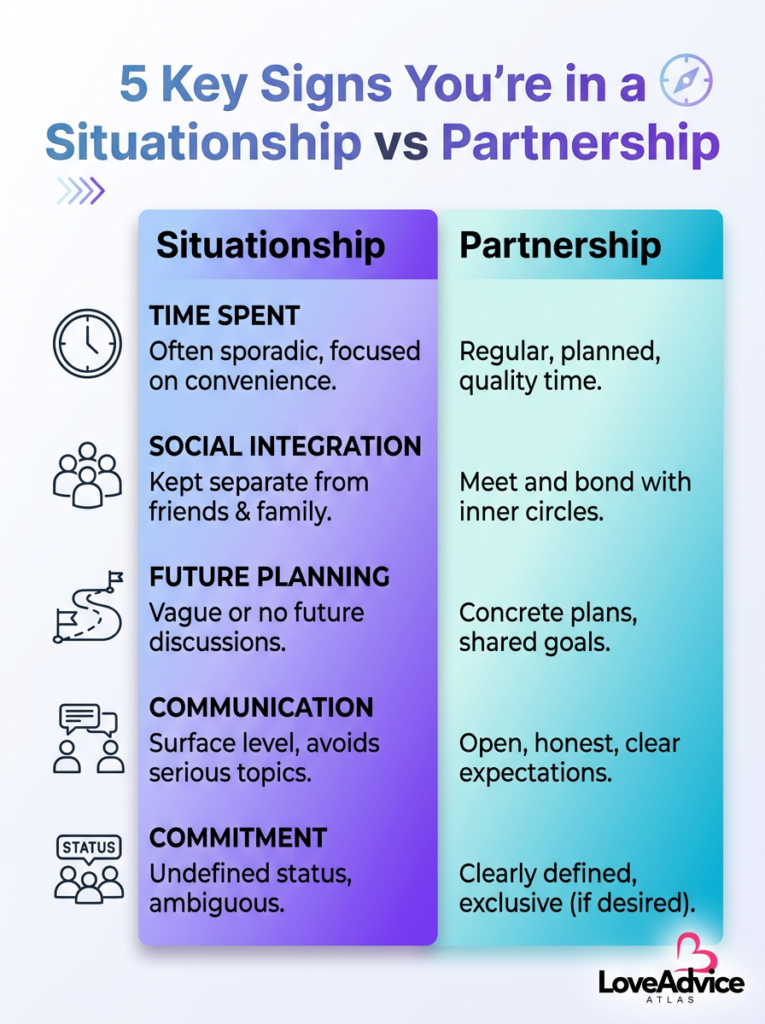
Five key signs distinguish a situationship from a partnership. Learn how commitment, communication, and boundaries shape your relationship status.
5. Practical Entanglements: Shared Lives vs. Parallel Tracks
Partnerships involve “practical entanglements” like shared finances, co-habitation, or integrated social lives. You are no longer two people living parallel lives, but a unit working toward common goals. If you are struggling with modern dating norms, remember that integration is a sign of safety. Situationships keep lives compartmentalized.
You might never meet their coworkers, and they may never have been to your home. This lack of integration ensures that the “exit costs” remain low, which is a major red flag for anyone seeking long-term stability.
Did You Know?
60% of daters in 2026 now demand ‘clear-coding’—unapologetic upfront intentions—before even meeting up to avoid the pitfalls of undefined arrangements.
6. Influence and Life Decisions: Do They Ask or Just Inform?
In a partnership, major life decisions are discussed as a team. Whether it is a job change or a cross-country move, your partner’s input is prioritized because your lives are intertwined. If you are dealing with broken trust or infidelity, the path to rebuilding always starts with restoring this mutual influence.
Situationships are characterized by independent evolution. They might inform you they are moving next month after the decision is already made. In these arrangements, you are an observer of their life rather than a participant in it.
7. Accountability and Integrity: The Building Blocks of Trust
Accountability means being responsible for how your actions affect the other person. In a partnership, there is a clear set of expectations and boundaries. We believe that high-stakes love requires high-stakes integrity. In a situationship, the “we never said we were exclusive” defense is common. This lack of accountability creates a breeding ground for anxiety and resentment. Without clear terms, there is no foundation for trust to grow.
8. Social and Legal Recognition: Public vs. Private
A partnership is recognized by the world around you. You are introduced as “my partner” or “my boyfriend/girlfriend” at social gatherings. This public validation is a powerful act that differs from mere agreement. Situationships often exist in the “private shadows.” You might be “the person I’m seeing” or simply a name on a phone screen. If your relationship is a secret or feels like a “hidden” part of their life, it lacks the weight of a true modern partnership.
Did You Know?
48% of men report holding back from emotional intimacy because they fear being ‘too much’ or overly invested, a primary driver of the situationship epidemic in 2026.
9. Communication Dynamics: Vulnerable Depth vs. Small Talk
Communication in a partnership is the invisible thread that weaves two lives together. It involves difficult conversations about money, kids, and long-term values. You might even use a wedding budget calculator as a way to practically plan for a shared future.
Situationship communication is often limited to “logistics” and “lightness.” You talk about what to eat or what movie to watch, but you avoid the “heavy” stuff. When the dialogue stops, the connection becomes a source of stress rather than solace.
10. Adaptability: Mutual Adjustment vs. Independent Evolution
Relationships require mutual adjustment. As you grow and change, your partnership adapts to accommodate those shifts. Using practical communication exercises can help you stay aligned through life’s transitions. In a situationship, there is no “mutual” adjustment. If one person’s life changes significantly, the relationship often simply ends because the “low-stakes” nature doesn’t support the effort required to adapt. You are expected to fit into their life as it is, or not at all.
Conclusion: Situationship vs Real Love in 2026
Distinguishing between a situationship and a partnership is essential for your emotional well-being in 2026. A partnership offers a source of solace and a shared destiny, while a situationship often leaves you feeling lonely in your connection.
We believe that choosing love should be an ambitious choice that empowers your career and personal identity. By recognizing these signs, you can demand the clarity you deserve and build a connection that is truly high-stakes and high-reward.